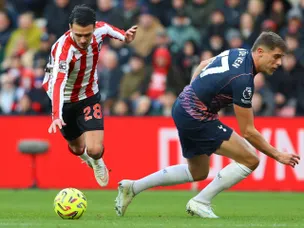
Chelsea have important decisions to make in the next transfer window, and three names deserve special attention: Malo Gusto, Jamie Gittens and Wesley Fofana. Between technical inconsistency, a low attacking return and recurring injury problems, keeping the trio could mean prolonging situations that have already had enough chances to produce results.
The London club need to maintain a competitive squad while adjusting the investments made in recent years. That means looking carefully at players who have not yet justified the trust placed in them. Persisting with a signing is not always the best route, particularly when performances do not match expectations and market opportunities exist to negotiate.
Malo Gusto, a chance to make money

Gusto is an interesting case because he is not a player without a place or completely forgotten in the squad. Since arriving at Stamford Bridge, the right-back has been given frequent opportunities, both in the starting line-up and off the bench. The problem is that the minutes he has accumulated have not turned into consistency. His performances are still marked by fluctuations, especially in defence, which is one of the aspects that demand the most consistency from a player in the position.
Gusto has interesting physical characteristics and can contribute going forward, but he still falls short in reading certain situations. There are wrong decisions, poor positioning and difficulty in sustaining a reliable level across games. For a team that wants stability and solidity, a full-back who alternates good contributions with worrying displays is a limitation that cannot be ignored.
A possible deal with Manchester City makes the scenario more favourable for an exit. City’s interest has grown because of Enzo Maresca’s admiration for the player, with whom he worked during his time at Chelsea. The boss knows his characteristics and may see use in a player who, despite his limitations in London, still has age and room to improve.
The financial side also matters. Signed from Lyon for about £25.5m (€30m), Gusto could bring in more than the initial investment, especially with another English club interested. The Blues would have the chance to turn a player who has not established himself as a reliable solution into a profitable sale. Insisting on technical recovery may be less advantageous than taking advantage of his market value while it remains high.
Jamie Gittens, a signing that has not taken off

The signing of Gittens was a considerable bet. The club paid about £47.6m (€56m) to take him from Borussia Dortmund, expecting to find in the young Englishman a winger able to offer speed, dribbling and depth down the flanks. The aim was to develop his potential within a project that usually invests in young players. So far, however, the return has been far from the investment.
Gittens has not produced a convincing run of performances. When given opportunities, he has alternated low-key contributions with unproductive displays, without showing the ability to change games that justified his signing. Physical problems have also hampered his adaptation and stopped him building a run of games.
The numbers show the difficulty: only one goal and five assists in 29 games for Chelsea. This season his involvement has been even more limited, with just two appearances, one of them as a starter.
It is true that Gittens is still young and can improve. However, potential cannot be the only argument for keeping a player who cannot turn opportunities into output. Chelsea have already invested a significant sum and need to assess whether there is a concrete prospect of a sporting return or whether they are simply prolonging an attempt that has not worked as hoped.
A loan exit would be an interesting alternative. Away from the pressure of Stamford Bridge, perhaps in a smaller market, the Englishman could regain confidence, gain minutes and try to develop aspects of his game that have not appeared regularly. A sale also deserves consideration, provided the Blues are willing to accept a considerably lower sum than they paid Dortmund. Recovering the full £47.6m looks unrealistic at the moment.
Wesley Fofana, a gamble that has cost too much

Of the three names, Fofana is perhaps the most delicate case. The centre-back joined Chelsea in 2022 for more than £68m (€80m), becoming one of the most expensive defenders in football history. The expectation was that he would become a reference point for the London defence for many years. What has happened since, however, has been a series of problems that have completely compromised his time at the club.
Injuries are the main obstacle. Fofana has been out for more than 690 days since arriving at Stamford Bridge, with serious knee problems and recurring muscle injuries. His long absence in 2023-24 and further physical problems in later campaigns have made any attempt to build a consistent run difficult. For a player who cost so much, availability should be a basic requirement, but it has become one of the biggest uncertainties.
The problem is that even when he is fit, the Frenchman does not convey the expected security. Fofana has speed, physical strength and good leap, important characteristics for a centre-back who must defend space and contest aerial balls. Even so, he often shows positioning errors, rashness in certain challenges and difficulty maintaining concentration for 90 minutes. Those limitations cannot be explained solely by his injury history.
Chelsea have to consider how far it is worth continuing to bet on a recovery that has not yet turned into reliability. Age is on Fofana’s side, at 25, but his time at the club already offers a considerable sample of his difficulty staying available and delivering the expected level. A sale would probably mean a significant financial loss, but it would also let the club end an investment that has not brought the planned sporting return. Instead of waiting for the centre-back to finally meet expectations, the Blues could direct the resources to a more reliable option.

 Malo Gusto
 Jamie Bynoe-Gittens
 Wesley Fofana
 Chelsea